Learn why expansion joints are necessary, the main system types, waterproofing and fire-rating requirements, common failures, and maintenance guidance.
Expansion joints are essential to the durability, waterproofing, fire safety, and long-term performance of buildings and infrastructure projects.
Here are 10 of the most important questions developers, consultants, contractors, procurement teams, and facility managers should ask about expansion joints.
1. Why Are Expansion Joints Necessary?
Construction materials naturally move because of:
Temperature changes
Concrete shrinkage
Structural settlement
Wind movement
Seismic movement
Static and live loads
Traffic and vibration
Without properly designed expansion joints, these forces can cause uncontrolled cracking, tile damage, concrete spalling, waterproofing failure, or pressure between adjoining structural sections.
Expansion joints allow this movement to happen safely while protecting the structure, waterproofing, and surrounding finishes.
2. What Is the Difference Between an Expansion Joint and a Control Joint?
An expansion joint separates structural elements and accommodates expected structural or thermal movement.
A control joint creates a planned weak point where shrinkage cracking can occur in a controlled and visually manageable location.
The key difference is:
Expansion joint: Accommodates movement between separated building sections.
Control joint: Controls where concrete or masonry is expected to crack.
A control joint should not automatically be treated as an expansion joint. Each requires a different design and treatment.
3. Where Are Expansion Joints Commonly Installed?
Expansion joint systems may be required in:
Commercial and residential buildings
Shopping malls and hotels
Hospitals and airports
Warehouses and industrial facilities
Parking structures and ramps
Bridges and highways
Podium and plaza decks
Roofs and façades
Basements and below-grade structures
Tiled floors and long corridors
Fire-rated walls and floors
The suitable system depends on where the joint is located and what functions must be maintained across the opening.
4. What Are the Main Types of Expansion Joint Systems?
Common expansion joint solutions include:
Sealant Joint Systems
These typically use a compressible filler, backing material, primer, and flexible sealant. They are commonly used for moderate movement in concrete, masonry, and façade applications.
Preformed Elastomeric Systems
Rubber, EPDM, PVC, or precompressed foam systems are designed to compress and expand repeatedly. Depending on the product, they may also provide waterproofing, fire resistance, acoustic control, or thermal insulation.
Metal Expansion Joint Covers
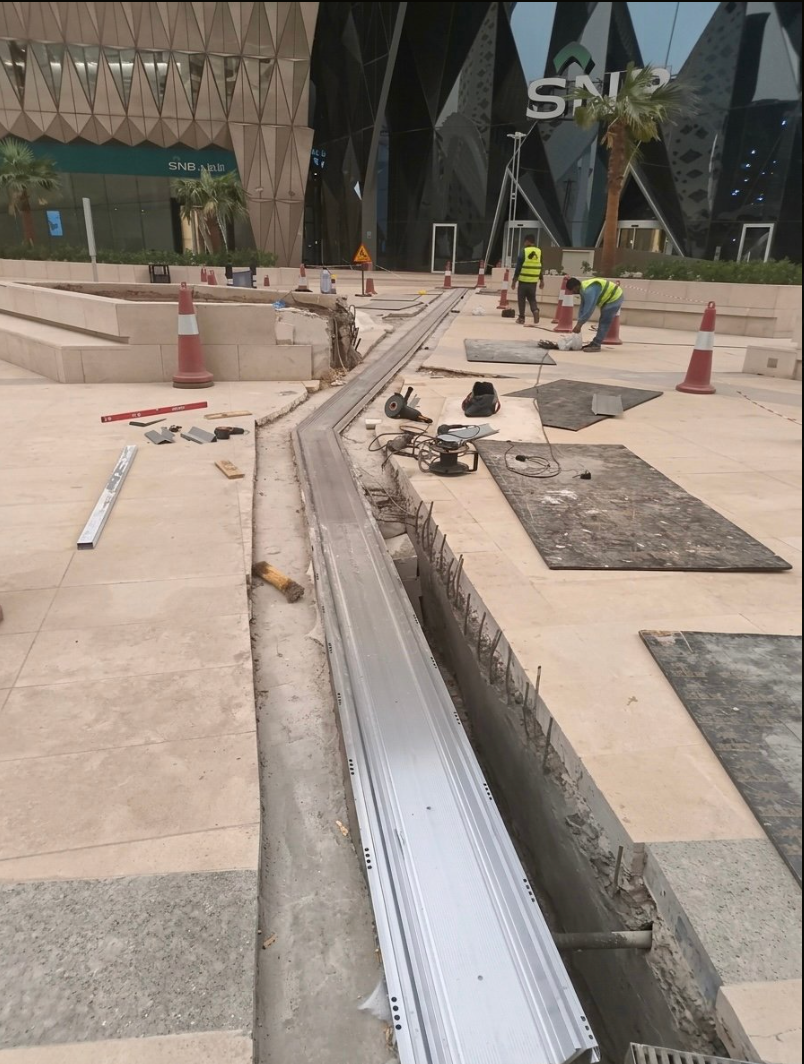
Aluminium, stainless-steel, or composite covers bridge the structural opening while allowing movement underneath. They are commonly used across floors, walls, ceilings, malls, hospitals, and parking areas.
Waterproof Expansion Joint Systems
These systems maintain watertightness across roofs, podiums, basements, bridges, wet areas, and other water-exposed structures.
Heavy-Duty and Bridge Expansion Joints
Bridge and infrastructure systems are designed for repeated vehicle loads, vibration, weather exposure, and multidirectional structural movement.
Fire-Rated Expansion Joint Systems
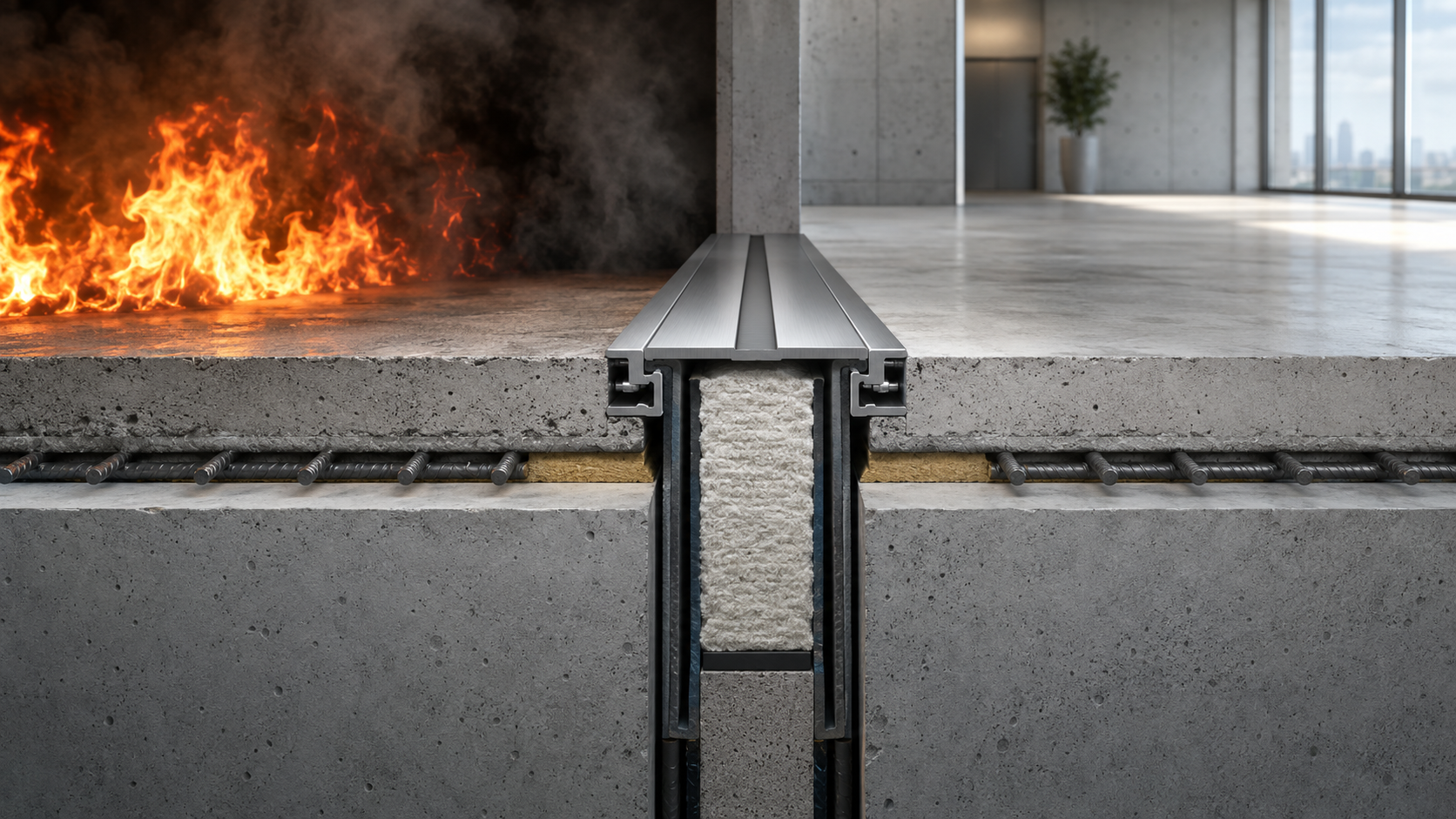
Fire-rated joints maintain the required fire resistance where a movement joint passes through a fire-rated floor, wall, or roof assembly.
5. Do Expansion Joints Need to Be Waterproof?
Not every expansion joint must be waterproof. However, waterproofing is essential where leakage could affect occupied areas, equipment, structural elements, or interior finishes.
Watertight expansion joints are commonly required in:
Bridge decks
Roofs
Parking decks
Podium slabs
Plaza decks
Basements
Tunnels
Wet areas
External walls
Structures above occupied spaces
Waterproofing must remain continuous at corners, intersections, terminations, upstands, and changes in direction. These transition points are frequently where leakage begins.
6. When Does an Expansion Joint Need a Fire Rating?
A fire-rated expansion joint is required when the joint passes through a fire-rated wall, floor, roof, or other rated assembly.
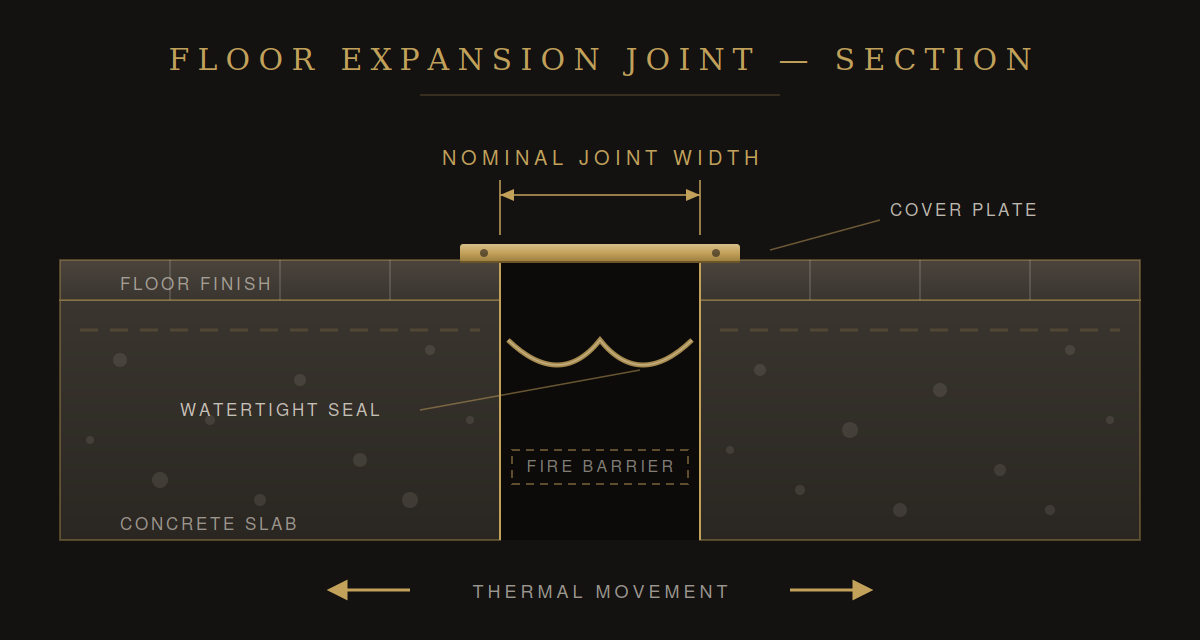
The fire-resistive system must accommodate movement while limiting the passage of flame, smoke, and heat for the required rating period.
A normal sealant, filler, or architectural cover does not automatically provide fire resistance. The specified system should have appropriate test documentation for its intended joint configuration and substrate.
Waterproofing and fire protection may also need to work together within the same joint assembly.
7. What Makes Bridge Expansion Joints Different?
Bridge expansion joints operate under demanding conditions that may include:
Repeated vehicle impact
Heavy traffic loads
Vibration
Thermal movement
Deck deflection
Water and debris
Oils and chemicals
Harsh outdoor exposure
A bridge joint must provide a safe and durable traffic surface while accommodating the calculated movement of the bridge deck.
Watertightness is also important because leaking joints can expose bearings, concrete elements, and supporting structures to water and contaminants.
8. Why Do Expansion Joints Fail?
Common causes of expansion joint failure include:
Insufficient movement capacity
Incorrect joint-width measurements
Wrong system selection
Poor substrate preparation
Weak or damaged concrete edges
Incorrect sealant dimensions
Missing or unsuitable primer
Improper anchoring
Misaligned profiles or cover plates
Incompatible waterproofing materials
Discontinuous transitions
Opening the area to traffic too early
Lack of inspection and maintenance
Many failures are coordination failures rather than product failures. A good product cannot correct an incomplete detail or unsuitable site condition.
9. Why Do Expansion Joints Start Leaking After Project Handover?
Leakage commonly develops when the expansion joint is treated as a separate product instead of part of the complete waterproofing system.
Typical weak points include:
Membrane-to-joint interfaces
Horizontal-to-vertical transitions
Corners and upstands
Changes in joint width
System terminations
Drainage interfaces
Connections between different materials
These concealed areas should be inspected and, where applicable, water-tested before cover plates and final finishes are installed.
Once the system is concealed, identifying and repairing the defect becomes more disruptive and expensive.
10. How Should Expansion Joints Be Inspected and Maintained?
Expansion joints should be included in the building or infrastructure maintenance plan.
Periodic inspections should check for:
Torn, hardened, or separated seals
Loose or damaged cover plates
Failed sealant adhesion
Concrete-edge deterioration
Corrosion
Water leakage
Debris restricting movement
Uneven or unsafe traffic surfaces
Damaged transitions and terminations
The inspection frequency should reflect the joint’s location, traffic, environmental exposure, and importance to the waterproofing or fire-protection strategy.
The Detail That Protects the Entire Assembly
An expansion joint crosses more than the structure. It may also pass through flooring, waterproofing, façades, roofing, fire-rated assemblies, and architectural finishes.
This means the joint must continue the performance of every system it interrupts while still allowing the building or bridge to move.
For developers, consultants, and contractors, the priority should be clear: coordinate the complete joint route before procurement and installation begin. Review every width, transition, intersection, termination, and change in plane—not only the visible section shown on the typical detail.
When expansion joints are treated as complete engineered assemblies, they protect the project from cracking, leakage, unsafe surfaces, and avoidable rectification work.
Need Support With an Expansion Joint Package?
Atlantis supports the review, supply, rehabilitation, and installation of expansion joint systems for building and infrastructure projects across Saudi Arabia.
Send your drawings, joint schedule, movement requirements, and project specifications to Atlantis for technical review.
Start a Conversation with Atlantis
LinaBukhari.com is a personal portfolio for educational and informational purposes only. All commercial, procurement, quotation, and project inquiries are directed to the official company, Atlantis.